
Vea también


 25.09.2026 11:02 AM
According to Santiment, the share of Ethereum held on monitored exchanges has fallen to a historic low. Only 3.49% of the total ETH supply is currently on these exchanges, meaning most coins have been moved off trading venues and aren't available for quick spot sales. The reason for this distribution is clear: roughly 35% of all Ethereum is locked in staking, earning holders rewards for participating in network validation, and about $53 billion is frozen in DeFi protocols on Ethereum, where coins are used as collateral or liquidity rather than assets ready for immediate exchange sale.

The causal logic is straightforward: the less Ethereum physically sits in exchange wallets, the narrower the supply actually available for trading becomes. With steady or rising demand, that limited supply can amplify price moves more strongly than during periods when large volumes of coins are concentrated on exchanges awaiting sale. The beneficiaries of this structure are existing Ethereum holders, whose positions are technically insulated from sudden selloffs coming from large exchange reserves. For new buyers, however, any spike in institutional or retail demand risks translating into faster and sharper price moves than the raw trading volume alone would suggest.
Notably, this structural signal overlays an overall positive market psychology: the Fear & Greed Index is at 71 — in the greed zone but below the extremes where market participants typically begin to take profits in anticipation of a correction. The combination of shrinking exchange supply and moderately elevated — but not extreme — risk appetite creates conditions in which the market can continue rising without an immediate technical overheating, which usually shows up when the index exceeds 80–85.
I wouldn't rule out that this combination — structural supply scarcity on exchanges plus moderate greed rather than euphoria — explains Ether's resilience to sharp pullbacks in recent weeks. A classic reversal at peak greed typically requires both overheated sentiment and excess exchange supply to sell into; right now only the first of those two factors is present.
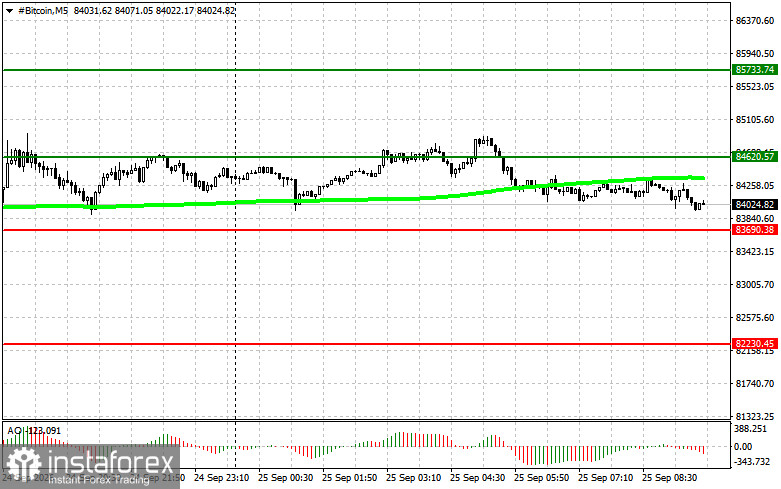
Bitcoin Bitcoin is trading in the $82,200–85,700 range, and the trading plan revolves around two mirrored scenarios for breakouts and rejections. A break above $84,600 triggers a buy activity, targeting $85,700, where profit should be taken and a reversal to short considered on a possible retracement. Entry conditions are mandatory: price must stay above the 50?day moving average, and the Awesome Oscillator must be in positive territory. The second buy scenario is a dip: if the price approaches the lower band at $83,600 but a downside breakout is not confirmed, treat that as a false move and open a long position, targeting $84,600 first and then $85,700 as a wider technical target if the rally extends beyond the near range.
Short positions are arranged symmetrically. A confirmed break below $83,600 leads to a sell activity, targeting $82,200, with mirror conditions: the moving average above price and Awesome below zero. The second short scenario works from a rejection at $84,600 if an upward breakout fails to confirm, opening a path to $83,600 and then $82,200.
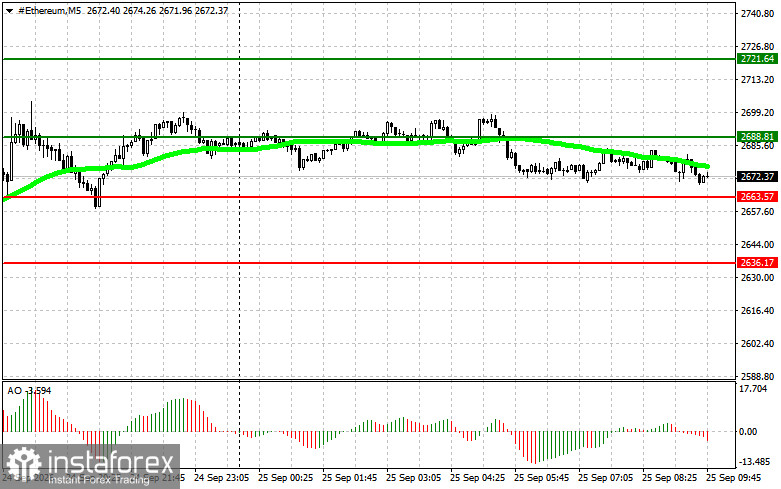
Ethereum technicals Ethereum is trading in the $2,636–2,721 range, and the logic mirrors Bitcoin's on its own price scale. A break above $2,688 signals a buy, targeting $2,721 under the same conditions — rising moving average below the price and Awesome above zero. The second buy variant is a dip at $2,663 if a downside breakout is not confirmed, aiming first for $2,688 and then $2,721 as a wider continuation target.
Sell setups for Ethereum start with a break below $2,663, targeting $2,636, if the price is below the moving average and Awesome is negative. The second sell works from a rejection at $2,688 if an upward breakout fails to confirm, with targets back to $2,663 and then $2,636. Both indicators are used purely as filters to weed out false moves, not as standalone reasons to enter early; decisions are made only after price confirms the specified levels.


